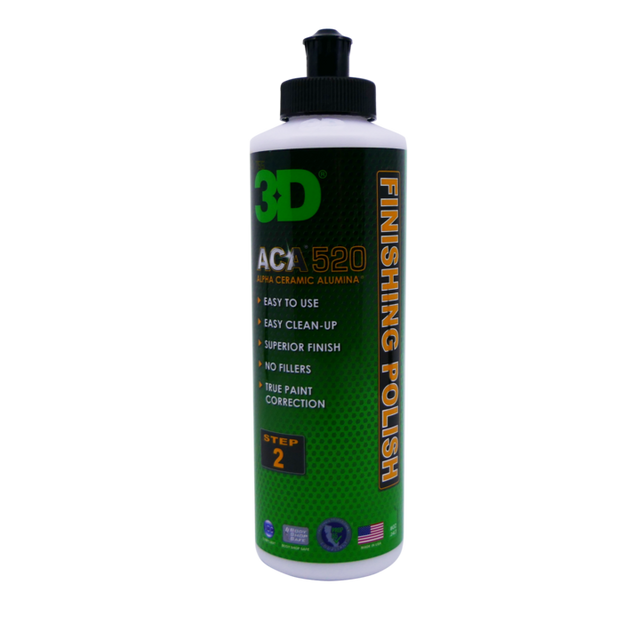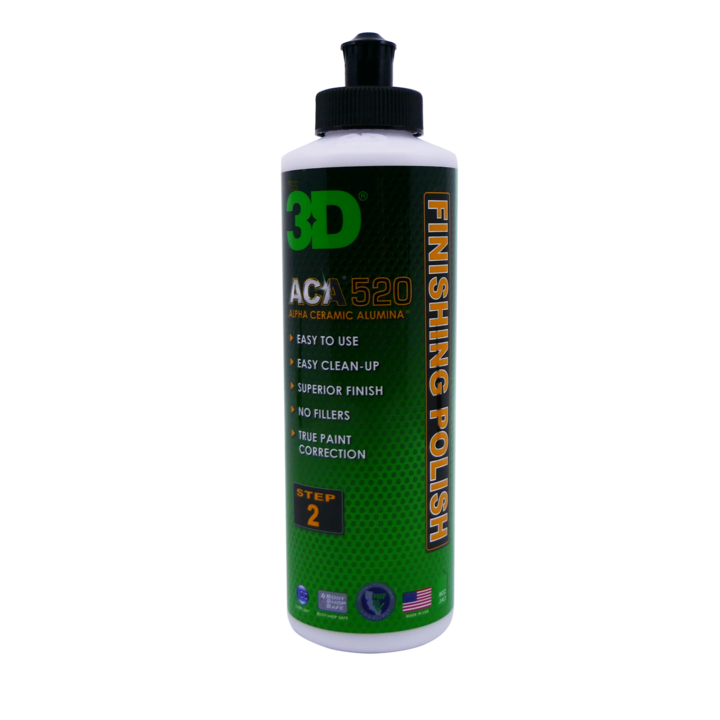
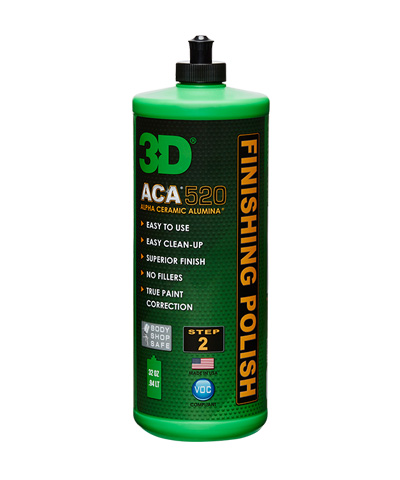
3D ACA 520 Finishing Polish
3D ACA 520 Finishing Polish - 946ml is backordered and will ship as soon as it is back in stock.
Couldn't load pickup availability

3D ACA 520 Finishing Polish
Description
Description
3D ACA True Paint Correction System – Compound & Finishing Polish
Achieve precise paint refinement with Finishing Polish - 3D ACA 520, the second step in the 3D ACA True Paint Correction System. Used after the 500 X-Tra Cut Compound, it helps refine the paint surface and enhance its overall appearance.
3D ACA 500 X-Tra Cut Compound
First, use the 500 X-Tra Cut Compound to address deeper paint imperfections. Its Alpha Ceramic Alumina technology provides efficient cutting while helping to control heat during polishing.
- Removes heavy swirls, sanding marks, and paint defects
- Works on various paint types, including hard ceramic clear coats
- Supports wool and foam polishing pads
- Contains no silicone, fillers, solvents, kerosene, or crystalline silica
- Available in 236 ml and 946 ml sizes
3D ACA 520 Finishing Polish
Next, apply the finishing polish to refine the surface after the cutting stage. Its fine formula works without fillers and helps create a clear, polished appearance.
- Refines the surface after compound application
- Reduces the appearance of holograms and fine polishing marks
- Enhances paint depth and colour
- Stays wet longer for easier application and efficient product use
- Works with a black foam polishing pad on rotary or DA polishers
How to Use the System
- First, apply the 500 X-Tra Cut Compound to correct deeper paint defects.
- Then, use the 520 Finishing Polish to refine the surface and improve clarity.
- Finally, inspect the paint under suitable lighting to check the finished result.
Why Choose the 3D ACA Paint Correction System?
The two-step system combines cutting and finishing in a straightforward process. Therefore, it suits both professional detailers and enthusiasts who want greater control over their paint correction workflow.
- Provides separate cutting and finishing stages
- Works with common rotary and DA polishing equipment
- Supports efficient product application
- Suitable for modern vehicle paint systems
Complete your paint correction process with the 3D ACA system and refine your vehicle’s paint with a controlled, professional detailing workflow.
Payment & Security
Payment methods
Your payment information is processed securely. We do not store credit card details nor have access to your credit card information.
Frequently Asked Questions
Can I use 520 Finishing Polish without using 500 X-Tra Cut Compound first?
Can I use 520 Finishing Polish without using 500 X-Tra Cut Compound first?
Yes. If the paint only has light defects or minor polishing marks, you may use 520 on its own. However, deeper defects may require a suitable cutting compound before the finishing stage.
Can I use 520 Finishing Polish on ceramic clear coats?
Can I use 520 Finishing Polish on ceramic clear coats?
Yes. The polish can be used on modern automotive paint systems, including vehicles with harder clear coats. Always perform a test spot first to determine the most suitable combination of pad, machine, and polishing speed.
Does 520 Finishing Polish contain fillers?
Does 520 Finishing Polish contain fillers?
No. The formula is designed to achieve the desired finish without relying on fillers. This helps you evaluate the actual condition of the paint after polishing.
How much product should I use for each polishing section?
How much product should I use for each polishing section?
Start with a small amount and spread it evenly across a manageable section. Using excessive product can make the polishing process less efficient, so adjust the amount based on the pad, working area, and paint condition.
Should I perform a test spot before polishing the entire vehicle?
Should I perform a test spot before polishing the entire vehicle?
Yes. A test spot helps you determine whether your chosen pad, machine, and polishing approach provides the desired result before you work on the entire vehicle. It also helps you avoid unnecessary polishing on areas that may already have sufficient correction.